
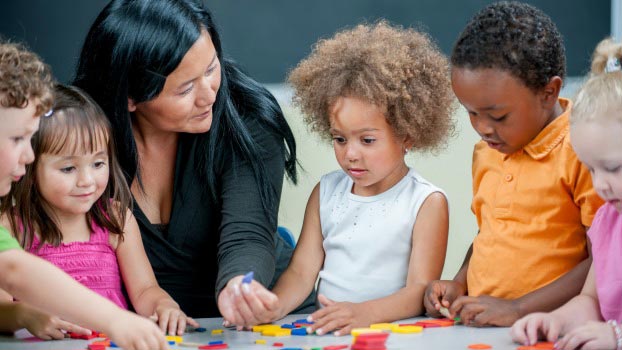
Those who teach preschool and early elementary students face unique challenges due to students’ limited language abilities. When a child enters the classroom with no English language skills at all, the obstacles to communication can be overwhelming. We asked author and educator, Karen Nemeth, M.Ed., to share some tips with you for welcoming limited English language students into the early childhood classroom. The result is an article full of powerhouse ideas that are easy to implement, but make a huge difference.
Making Children Who Speak Other Languages Feel Welcome
by Karen Nemeth, Guest Blogger
“A new child just started in my preschool class today, and she doesn’t seem to speak a word of English! What should I do?” I hear this question more and more often as young children from different language backgrounds are the fastest growing segment of our population. Research tells us it is important to provide support of each child’s home language during the early years. Here are a few steps any teacher can take to help all of her children learn the languages of their friends and neighbors. Let’s get started!
Start with a greeting!
Get to know each family and find out exactly what language the child speaks at home so you can plan for their first day of school. Learn how to pronounce each child’s name and the greeting in their language.
This is important for the child’s self esteem and builds a community that celebrates diversity.
Think of “survival words”!
Make a list of about 20 terms that will help any child feel more comfortable on his or her first day – such as yes, no, bathroom, eat, drink, stop, come, hurt, help, clean up, good job and ‘mommy will be here soon’. Send the list home with the parents – even include a small voice recorder. Ask them to write or record the correct pronunciation. This helps the teacher form a bond with each new child. It is even better if all of the children can learn a few words to help their new friends. And, these words are much more useful than learning the days of the week or counting to ten! Make new words easier to learn by adding them to a song or chant.
Then add words that work!
Once you get started, you will find that all children are interested in learning the languages of their friends – but it takes practice. As you are adding to everyone’s vocabulary, try to include words they will actually use several times a day in play, during regular class activities, at mealtimes, greetings or goodbyes. What words do children need to know – or WANT to know – so they can play and learn together? If they love the dramatic play kitchen area – introduce words like hot, cold, good, not good, cup, plate, fork, spoon, napkin, more, please, no, thank you, and all finished. They’ll be able to use these words during playtime, during school snack and at dinner with their family! Focus on words you and the children will use every day. Post pronunciation cue cards or labels to help the staff remember the useful new words.
As our country becomes more diverse and we strive to prepare children to be successful in a global economy, learning other languages is always a plus. Teachers of young children can use their best techniques like storytelling, singing, using gestures and silly voices to make a lively language learning experience for everyone!
Karen Nemeth is the author of Many Languages, One Classroom: Teaching Dual and English Language Learners (Gryphon House, 2009) She has an M.Ed. from Rutgers University. She has been a teacher and a teacher educator for more than 25 years, and has presented at national, state, and local conferences on topics related to first and second language development. She is on the executive board of NJ Teachers of English to Speakers of Other Languages/NJ Bilingual Educators and is co-coordinator of the Early Childhood Special Interest Group. Currently, she teaches at William Paterson University and consults with programs throughout the country. For more information about young English language learners, visit her website at http://www.languagecastle.com.
Children feel very uncomfortable for their native languages because other students do not speak it and above all it is not also used in teaching. So, they face problems to cope up with the situation and fail to learn properly. For this a teacher can play a great role in helping the student to be acquainted with English. A teacher should try several methods for making the students to get used with English. Like, try to use some easy words for them in the classroom as well as to provide the words to their parents so that the students can practice it in home. At the time of playing at the playground during recess, at time of meal, co-curricular activities and to greet others, they can use English which will help them enrich their vocabulary as it is stated above. Cleanly it would be a stepping stone for the children. Thanks for sharing such valuable thoughts, Karen Nemeth. Keep up the good work.